This Is What Happens When Culture Comes Alive in Boudhanath
You know that feeling when a place just gets to you? Boudhanath wasn’t just a stop on my Nepal trip—it hit me in the soul. The moment I stepped into that swirling circle of prayer flags, butter lamps, and chanting monks, I realized this wasn’t just sightseeing. It was a living, breathing cultural heartbeat. If you’re looking for authenticity, this is where it lives. Let me take you through why.
Arrival: First Impressions of a Spiritual Hub
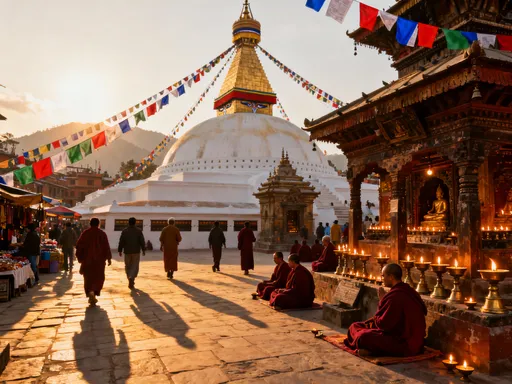
The first glimpse of Boudhanath Stupa appears as a quiet revelation amid the dust and clamor of Kathmandu’s eastern outskirts. As you approach, the air changes—thicker with the scent of juniper incense, butter lamps, and the faint musk of woolen robes. Prayer flags, faded by sun and wind, snap above in a constant whisper, carrying mantras into the sky. The stupa rises with solemn grace, its whitewashed dome crowned by a golden spire, and the all-seeing eyes of Buddha gazing out in four directions. This is one of the largest stupas in Nepal and a cornerstone of Tibetan Buddhist life outside Tibet itself, a sanctuary for monks, pilgrims, and the local Tibetan-Nepali community.
Visitors often pause at the edge of the circular path, absorbing the rhythm of devotion. Pilgrims, many wrapped in maroon and saffron, walk the kora—clockwise circumambulation—murmuring prayers, fingers sliding over mala beads. Others spin the heavy brass prayer wheels set into wooden frames, each rotation believed to release the mantras within. The sound is a steady hum: low chants, the clink of metal, the occasional bark of a stray dog. Yet within this sensory richness, there is stillness. The stupa radiates a calm that seems to soften the edges of the surrounding city. Even the children who dart between stalls return to the path, following their parents with small, serious steps.
What strikes most is the seamless blend of sacred and ordinary. A woman in a patterned apron lights a butter lamp before hurrying off to market. A monk pauses to adjust his phone strap while continuing his chant. There are no barriers between worship and daily life. This integration is not staged for visitors; it is lived. Boudhanath is not a monument frozen in time, but a dynamic center where tradition pulses through modern existence. For many women, especially those raising families and managing households, this balance between devotion and duty feels deeply familiar—a reminder that spirituality need not be separate from routine.
A Day in the Life: Rhythms of Devotion and Daily Culture
Dawn at Boudhanath begins with the deep, resonant tones of monks chanting inside the monastery. The morning light, soft and golden, spills over the stupa’s dome as the first pilgrims complete their kora. By 6 a.m., the eastern side of the stupa is lined with figures in motion—elders leaning on walking sticks, young mothers guiding toddlers, monks in orderly rows. The air is cool, the streets still quiet except for the occasional rickshaw. This is the most intimate time to visit, when the energy is contemplative and the space feels almost private, despite the growing number of people.
As the sun climbs, the neighborhood awakens. Small tea houses begin to steam with the scent of butter tea and fried dumplings. Locals gather at low wooden tables, sipping from chipped mugs and sharing quiet conversation. Some pause mid-meal to turn a prayer wheel or bow their heads briefly. Schoolchildren in uniforms skip past vendors selling marigolds and incense, their laughter blending with the low drone of mantras. Shopkeepers light butter lamps behind counters before opening for the day. Even in these small gestures, the sacred is woven into the fabric of the everyday.
By midday, the temperature rises, and the pace slows. Monks retreat to shaded courtyards for study. Pilgrims rest on stone benches, fanning themselves with folded scarves. Yet the ritual never stops. Every few hours, a new group gathers for collective chanting in the monastery hall. The sound rises and falls like a tide, filling the surrounding alleys with a sense of continuity. For women who often navigate the demands of caregiving, this steady rhythm offers a quiet kind of strength—the reassurance that devotion is not about grand gestures, but about showing up, again and again.
Evening brings a different kind of beauty. As the sun dips behind the rooftops, the stupa is lit from within, its eyes glowing with a golden warmth. Butter lamps flicker to life along the base, their flames dancing in the breeze. Families return for a final walk, children now tired but still clinging to the ritual. The scent of incense grows stronger, mingling with the evening air. There is a sense of closure, but also of renewal. Each day at Boudhanath is both an ending and a beginning, a cycle that honors time without rushing it.
Beyond the Stupa: Exploring the Surrounding Community
The magic of Boudhanath extends beyond the stupa’s immediate circle. The surrounding neighborhood, a maze of narrow alleys and low-rise buildings, feels like a living extension of the spiritual site. Here, Tibetan culture thrives in intimate detail. Shops display hand-painted thangka scrolls, intricate mandalas rendered in mineral pigments on cotton. Jewelry stalls offer silver amulets, dzi beads, and prayer boxes engraved with mantras. Fabric stores hang bolts of brocade and handwoven wool, patterns passed down through generations.
What stands out is the absence of mass-market souvenirs. Unlike tourist-heavy areas in Thamel or Pokhara, Boudhanath’s shops cater primarily to locals and serious pilgrims. You won’t find plastic prayer wheels or cartoonish Buddha statues. Instead, the goods are functional and meaningful—meditation cushions, ritual scarves, incense burners. Vendors speak softly, often in Tibetan or Nepali, and greet visitors with a nod rather than a sales pitch. There is no pressure to buy, only an invitation to observe and, if you wish, participate.
The food scene is equally authentic. Small eateries serve steaming plates of momos, handmade with care and served with spicy tomato-chili chutney. Butter tea, salty and rich, is poured from large thermoses into chipped ceramic cups. Some cafes offer simple noodle soups or tsampa porridge, traditional staples for monks and travelers alike. These meals are not curated for foreign palates; they are what people eat every day. Sitting at a wooden bench, sharing a meal with a family from Ladakh or a group of nuns from Sikkim, you feel less like a tourist and more like a guest.
Residents move through their days with a quiet dignity. Women carry shopping bags from the local market, stopping briefly to spin a prayer wheel on their way home. Elderly men sit on doorsteps, fingers moving over malas as they watch the world pass. Children play hopscotch near the stupa’s base, their chalk-drawn squares fading by afternoon rain. There is a deep sense of belonging here, a community anchored in shared belief and daily practice. For women who often feel pulled in multiple directions, this rootedness is both comforting and inspiring.
The Art of Mindfulness: Participating in the Culture (Not Just Observing)
Many travelers come to Boudhanath to witness, but the deeper experience lies in mindful participation. Walking the kora with intention—feet on stone, breath steady, mind quiet—can become a form of meditation. I began my visits by simply observing, camera in hand, eager to capture the perfect shot. But over time, I learned to put the lens down. I started walking the path slowly, matching my pace to the elders around me. I learned to keep my hands clasped, my voice low, my steps respectful.
There are unspoken rules that guide behavior here. Visitors are expected to walk the kora clockwise, following the flow of energy and tradition. Dressing modestly—covering shoulders and knees—is not just polite but necessary, a sign of reverence. Speaking in hushed tones, especially near meditation halls, helps preserve the space’s tranquility. Photography is allowed, but it should never disrupt prayer. Monks should not be photographed without permission, and rituals should never be mimicked for a photo opportunity. These guidelines are not restrictions, but invitations to engage with humility.
Sitting quietly during a chanting session, I felt a shift. The sounds, once foreign, began to settle into my chest. The rhythm matched my breath. I didn’t understand every word, but I felt the intention behind them—compassion, gratitude, release. This is the power of presence. In a world that often values speed and spectacle, Boudhanath teaches the opposite: that meaning grows in stillness, in attention, in simply being.
For women who spend so much of their time doing—cooking, cleaning, caring, planning—this lesson is profound. To sit without purpose, to walk without destination, to listen without response—these are radical acts of self-kindness. Boudhanath does not demand performance. It offers permission to slow down, to reconnect, to remember that you, too, are part of something larger.
Why Boudhanath Stands Out in a World of Tourist Traps
In an age where spiritual destinations are often reduced to photo backdrops, Boudhanath remains remarkably intact. Unlike sites that have become performative—where rituals are repeated on schedule for tourist cameras—this stupa functions first and foremost as a living religious center. More than 300 monks reside in the surrounding monasteries, and daily prayer sessions continue regardless of visitor numbers. The morning and evening pujas are not shows; they are essential practices, sustained by devotion, not demand.
The 2015 earthquake damaged the stupa’s spire, but the community rebuilt it with care, using traditional methods and materials. The restoration was not about tourism recovery, but cultural survival. Funds came from local donations and international Buddhist networks, not government marketing campaigns. Today, the stupa stands as it did before—its eyes watching, its dome glowing, its message unchanged.
What protects Boudhanath from over-commercialization is its community ownership. The area is not managed by a tourism board but by resident monks, families, and religious councils. Shops are family-run. Guesthouses are often homes converted with care. There are no chain restaurants, no loud bars, no souvenir stalls selling trinkets. Even the signage is minimal. This is not exclusionary, but protective—a way of preserving authenticity in the face of change.
For women who value integrity and depth, this resilience is deeply moving. It proves that places can evolve without losing their soul. Boudhanath does not resist modernity; it absorbs it. You’ll see monks with smartphones, children with school backpacks, women paying with mobile wallets. But these elements do not dilute the culture—they show how it endures, not in spite of the modern world, but within it.
Practical Tips for a Meaningful Visit
To truly experience Boudhanath, timing matters. The best hours are early morning, between 6 and 8 a.m., when the light is soft and the air cool. This is when locals are most active, and the atmosphere is most intimate. Late afternoon, around 4 to 6 p.m., offers a different beauty—the stupa bathed in golden light, butter lamps beginning to glow. Avoid midday, when heat and crowds can make the space feel overwhelming.
Dress with respect. A light scarf can cover shoulders, and long skirts or pants are appropriate. Comfortable walking shoes are essential, as the stone path can be uneven. Bring a reusable water bottle—hydration is important, especially at altitude—and consider carrying a small offering, like a few rupees for a butter lamp or a marigold for the shrine. These small gestures are appreciated, not because they are required, but because they reflect intention.
Choose accommodations wisely. Several family-run guesthouses surround the stupa, offering clean rooms, warm blankets, and simple breakfasts. Staying nearby allows you to experience the morning chants from your window and return to the site at quiet hours. These stays often support local women who manage the homes while their husbands serve in monastic roles or work in thangka painting.
Finally, practice restraint. Avoid loud conversations, intrusive photography, or touching sacred objects. Do not walk between monks during prayer, and never turn your back to the stupa while on the kora. If you wish to meditate, find a quiet corner and sit with humility. This is not your space to claim, but to honor.
Conclusion: Carrying the Culture Forward
Boudhanath changed the way I think about travel. It reminded me that the most powerful journeys are not about distance, but depth. To stand in a place where culture is not performed but lived—that is rare. It is a gift. For women who carry so much in silence, who nurture others while often forgetting themselves, Boudhanath offers a quiet invitation: to pause, to breathe, to remember that you, too, are sacred.
True cultural immersion is not about collecting experiences like souvenirs. It is about opening yourself to connection—across language, across belief, across time. It is about recognizing that a place like Boudhanath does not exist for us, but allows us to witness something greater. When we approach it with humility, with curiosity, with respect, we carry a piece of its light with us.
As I left Kathmandu, I kept returning to the image of the butter lamps—hundreds of tiny flames flickering at dusk, fragile but persistent. They do not fight the darkness; they simply refuse to let it win. In a world that often feels loud and uncertain, that quiet resistance is a lesson worth holding. Boudhanath is not just a destination. It is a reminder that culture, when lived with heart, can endure. And that, perhaps, is the most beautiful journey of all.